
Fertilisation
Before fertilisation can occur the sperm must undergo capacitation whilst migrating to meet the egg. Syngamy, therefore, occurs in the ampulla of the uterine tube around 12-24 hours after ovulation. Once penetrated by the sperm the egg becomes ‘activated’.
Fertilisation involves many stages;
1. The sperm passes granulosa cells surrounding the egg and attaches to ZP3 glycoproteins on the zona pellucida of the egg. This is through ZP3 receptors on the sperm cell membrane that are revealed during capacitation.
2. As a result of this binding the sperm undergoes the acrosomal reaction; this is when the acrosomal cap breaks down. An increase in calcium inside the sperm cell causes exocytosis of its contents and so the hydrolytic enzymes present are liberated and these can locally dissolve the zona pellucida. Two of these acrosomal enzymes are hyaluronidase (binds granulosa cells together) and acrosin (a protease).
3. The sperm is now able to penetrate the zona pellucida due to this enzymatic activity but also through mechanical action. Sperm motility changes and it becomes hyperactivated, 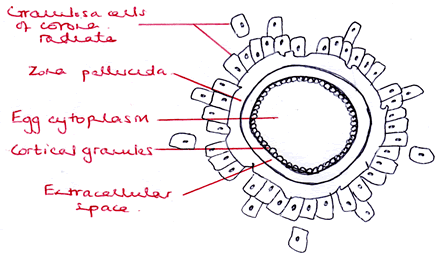 going from linear to ‘dance’ type movements/oscillations which pushes the sperm forwards into the egg.
4. Microvilli on the exterior of the egg surround the sperm through specific proteins on each of their surfaces. This causes fusion of the membranes and the contents of the sperm cell are released into the egg.
Fig. 6. Layers of an Egg. Hand produced.
5. The egg undergoes the cortical reaction due to an increase in calcium triggered by sperm penetration. Cortical granules, which are found just beneath the plasma membrane, fuse with this membrane. The exocytosis of these granules releases enzymes that act on glycoproteins found on the zona pellucida and causes them to harden. This prevents further sperm entry.
6. The increase in calcium also causes the egg to complete its 2nd meiotic division explaining why eggs only complete meiosis if they are fertilised. (See ‘Overview of Oogenesis’ below).
7. The sperm and egg nuclei initially have tightly coiled/condensed DNA, which protects the DNA. These starts to decondense to form pronuclei that fuse to form a zygote, which now has a diploid set of DNA. If decondensation fails, fertilisation fails.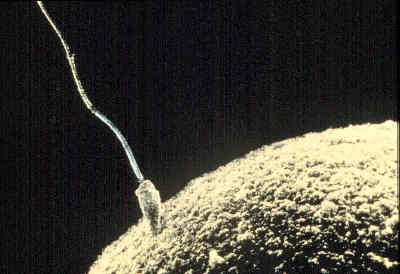
In contrast to what is generally believed the first sperm to reach the egg is not the one to fertilise it! Sperm must first penetrate the granulosa cells and zona pellucida that surround it and hundreds of sperm may be needed to clear a path for the one that penetrates the egg proper. When a path has been cleared, a sperm binds to the zona pellucida and releases its enzymes, digesting a pathway through it until it contacts the egg itself.
Fig. 7. Sperm Penetration. Image courtesy of Wikimedia Commons.
It is important to note that the sperm cell itself does not actually enter the egg, the membrane of the head and midpiece fuses with that of the egg to allow the release of their contents. However, the egg destroys the sperm mitochondria present in the midpiece and passes only maternal mitochondria onto the offspring. In humans, once this has occurred, the tail detaches quickly.
Prevention of Polyspermy
Fertilisation combines the haploid (n) set of sperm chromosomes with the haploid set of egg chromosomes and produces a diploid (2n) set. Polyspermy would produce a triploid (3n) or larger set of chromosomes and the egg would die. Importantly in humans, the egg has two mechanisms for preventing this;
1. Fast-block: binding of the sperm to the egg opens sodium channels in the egg membrane. The rapid inflow of sodium depolarizes the membrane and inhibits the binding of any more sperm to it.
2. Slow-block: involves secretory vesicles called cortical granules just beneath the membrane of the egg. Sperm penetration triggers an inflow of calcium which then starts the cortical reaction. Here the cortical granules release their secretion between the zona pellucida. This secretion swells with water and pushes any remaining sperm away from the egg and creates an impenetrable fertilisation membrane.